Entang Wiharso was born in Tegal, Central Java, 1967.
Education
1994: Indonesian Institute of Arts
Selected Solo Exhibitions
2007: "Intoxic," Rumah Seni Yaitu, Semarang
2006: "Puppet Blues," Western Michigan University, Kalamazoo, USA
2005: "Inter-Eruption," Bentara Budaya, Jakarta
2004: "Sublime Tunnel," Circle Art Space, Jakarta; "Hurting Landscape: Between Two Lines," Gallery Agniel, RI, USA
2003: "Hurting Landscape," Rhode Island Foundation Gallery, USA; Circle Point Art Space, Washington, D.C., USA
2002: "NusaAmuk," Indonesian National Gallery & Nadi Gallery, Jakarta; "Amuk," CP ArtSpace, Washington D.C., USA
2000: "Entang Wiharso," Chouinard Gallery, Hong Kong; "Melting Souls," Gallery Agniel, Providence, Rhode Island, USA; "Visit to Sacred Place: Cultural Interrogation," TamanMartani
1999: "Melting Souls," Hewlett Gallery, Carnegie Mellon University, USA
1997: "Strange Journey," Native Gallery, Providence, Rhode Island, USA
1996: "Idea is Form," National Gallery Indonesia, Jakarta
1995: "Conflict, Dreams & Tragedy," Purna Budaya Art Center, Yogyakarta
1994: "Final Work," Sasana Ajiyasa, Art Institute of Indonesia, Yogyakarta
Selected Group Exhibitions
2008: Indonesian Invasion, Sin Sin Fine Art, Hong Kong; "The Third Space: Cultural Identity Today," Mead Art Museum, Amherst, USA
2007: "Wind from The East," Kiasma Museum of Contemporary Art, Helsinki, Finland; 2nd Biennale Open Biennale terra Cotta, Dumaguete, Philippines; "Indonesian Contemporary Art Now," Nadi Gallery, Jakarta
2006: "Interpreting," Semar Gallery, Malang, East Java; "Waging Peace," Hera Gallery, RI, USA; "Jakarta Biennale XIII," Indonesia National Gallery, Jakarta; "Encounter," National Museum of China, Beijing, China
2005: "Actualizing Insight Virtuality," Indonesian Pavilion, 51st Venice Biennale, Italy; "Second Beijing Biennale," Beijing, China; "Jakarta Biennale XIII," Indonesia National Gallery, Jakarta; "Urban/Culture," CP Biennale, BI Building, Jakarta; "Here & Now," Yogyakarta Biennale VIII, Yogyakarta
2004: "Olympiade," Nadi Gallery, Jakarta; "Wings of Color, Wings of Words," Kyai Langgeng Art House, Magelang
2003: "Passion: Etno-Identity," Capital Library Gallery, Beijing, China; Leu Hai Su Art Museum, Shanghai, China & Galeri Canna, Jakarta
2002: "Re-creation," Museum H. Widayat, Magelang; "The Mind's Eye of Democracy," Taman Budaya, Surakarta
2001: "Not I, Am I?," Nadi Gallery, Jakarta; "Not Just the Political," Museum H. Widayat, Magelang; "The Problematic Desire," Casa de Cantabria, Madrid, Spain
2000: "Indonesian Contemporary Art: A Cultural Journey," Museum of Modern Art, Moscow, Russia; "One Hundred Years of Modern Indonesian Art," One Gallery, Jakarta
1999: "Art Beat," BankRI, Providence, Rhode Island, USA; 6th Yogyakarta Biennial, Purna Budaya Art Center, Yogyakarta
1998: 11th Indonesia National Biennial, Taman Ismail Marzuki, Jakarta
1995: "Fifty Years of Freedom: Return of the Heart," Vela Art Gallery, Amsterdam, The Netherlands
1993: Bentara Budaya Art Centre, Yogyakarta
1991: 3rd Yogyakarta Arts Festival Exhibition, Benteng Vrederburg Museum, Yogyakarta
1989: "Reli Sketching," Sasana Ajiyasa, Art Institute of Indonesia, Yogyakarta
1988: Sasana Ajiyasa, Art Institute of Indonesia, Yogyakarta
1987: Art Institute of Indonesia, Yogyakarta
Proper and Property
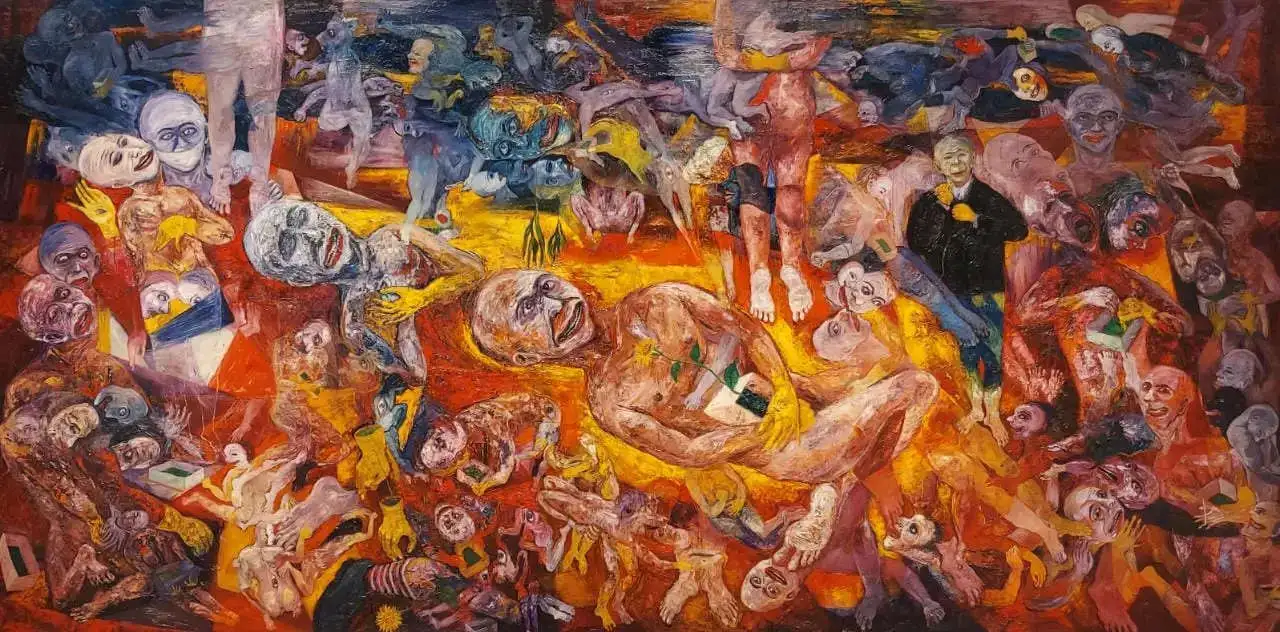
200 cm x 400 cm / Oil on Canvas
2003
Konsep Karya
This work is part of a body of work with the theme "Sublime Tunnel," created after Soeharto stepped down from the presidency. This period of tumult led to a period known as "Reformasi" (reformation) where people had newfound freedoms on many fronts. This work reflects a condition where emotions were released—people were talking, but also screaming to release their emotions that had been repressed. While this expression of emotion was a good thing, it was also a bad thing because many people lost their orientation, both in politics and in individual lives. I understood this "loud," difficult time as a period of sublimation. The composition of this work reflects the structure of the period, with a "repeated" central figure. (See the main figure with the same figure repeated above and to the left, in white). This is a symbol of hope or praying. People often pray by using one word over and over to sublimate themselves or to achieve a transcendental state. The clasped hands of the repeated figure represent this transcendental state. The hands of the main figure hold a small plant as a symbol of growing hope, the box representing "property" or possession in the physical world, where for such a long time people’s physical realities were controlled by those in power. And this control of the physical also led to control of the mind, causing tremendous suffering and injustice. Screaming was a process of sublimation, a cathartic process that would allow people to move beyond the oppression they had experienced to find a new place of hope, a new way of living. This is where the question of "proper" and "property" is expressed.